
The Football Gods are cruel. Scotland knows this – on the day I am writing this, Scotland will kick off at 8pm against Hungary with the opportunity to go through to the group stage for the first time in any major international competition ever. Group E – Romania, Belgium, Slovakia, and Ukraine – are all on three points with one game to go. Georgia, who has played the most exciting football of the whole tournament, looks destined to be knocked out to the dismay of the neutral.
And then there’s England. When I wrote my post after the England-Serbia game, I said I was fine with England playing boring football. ‘Ah ha!’ the Football Gods say. ‘You’re fine with boring football, are you? Then here: have the most boring game of football in the tournament so far!’
The English do have a disposition to overreact, especially when it comes to football. This is something I have become much more aware of living north of the Tweed. But if anyone watched that game, they can sympathise and agree with the fact that we were god-awful. England looked flat and tired, with no ideas, no creativity, and no solutions to any of the problems placed before them.
(A quick note: the rest of this post will be dedicated to a deep dive in England, so I do want to give Denmark their dues right here. They were attacking and dynamic. Huljmand’s goal continues this tournament’s great trend of long-range net-breakers, and Eriksen played so well that you wouldn’t have believed he died. Well done Denmark – I look forward to seeing you in the knockouts.)
Where to start with England? Well, the start and end of the discussion comes down to one thing: the Press. In footballing terms, a Press is when one team puts pressure on the other in an attempt to prevent them from attacking and to try and win the ball back. Very basically, Figure 1 below shows Red 5 with the ball. Blue 6 and Blue 8 press him, rapidly closing him down and suffocating any options he may have to advance or pass to a teammate (Figure 2). In an ideal Press, a Blue player (in this case, Blue 8) will come away from this engagement with the ball. (Figure 3). Any other Red players must immediately switch from attack to defence, Red 5 is out of position and will have left a gap in the Red’s formation, and Blue 8 can either charge forward to create an Overload, or he can quickly pass the ball to any of his teammates ahead of him so that they can take advantage.


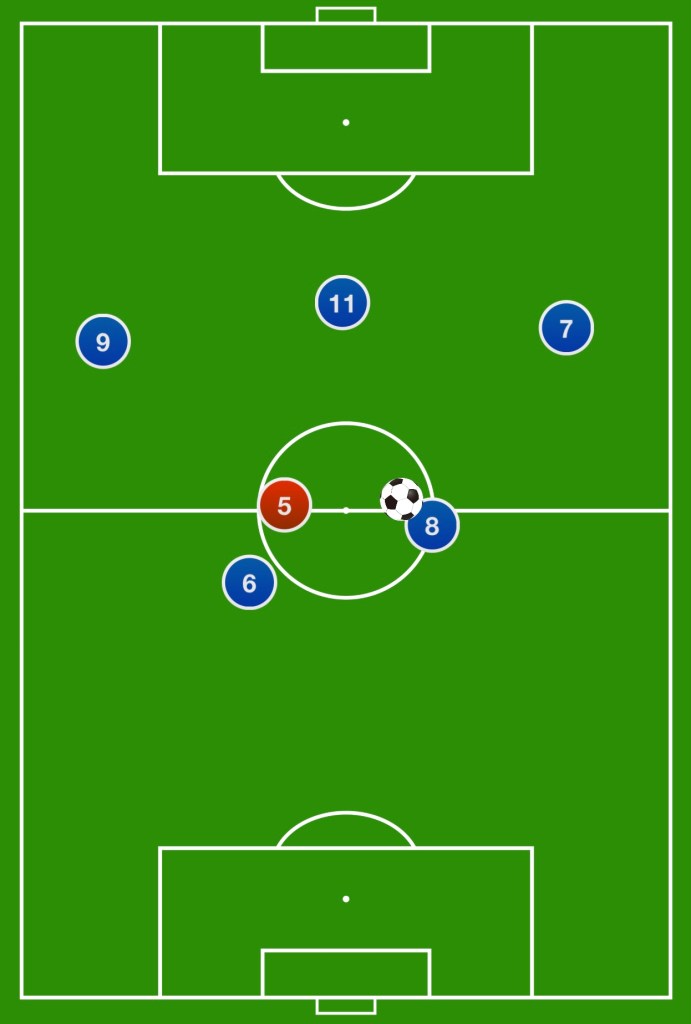
That is the basics of the Press: put pressure on the opposition, cause an error or win the ball, and immediately counter-attack. When done right, with players of the correct athletic profile and who have been coached in that system, it is devastating. Manchester City play with a Press. As do Arsenal, Liverpool, and Manchester United (kind of). In fact, most top-flight English teams play with some sort of Press. Every single player in this England squad has at some point over the last two years played a match in which they had to press. So why don’t England?
England’s tactics against Denmark effectively boiled down to threading the ball along the wings, trying to cross it into the box, and then sitting back in a low block once we had taken the lead. No intense pressing. No real press at all, in fact. Frustration doesn’t really cut it.
So what’s the issue? Well first of all, it IS Gareth Southgate. Now it has to be said that the current England manager has done a whole lot for the national team: he’s repaired its image, improved relations with the media, and has taken a lot of the weight out of the shirt. But when he gives an interview saying he doesn’t have the players to press when they have been pressing all season, it makes you think that he doesn’t have any idea how to utilise the talent he has.
He is right about one player, however: Harry Kane. Kane doesn’t press. He hangs back much farther down the pitch than other strikers. He then receives the ball and holds it up to allow wingers and wide players to make the runs before passing it to them or laying it off to a midfielder who then sets them going. A full-team press only works when everyone presses high up the pitch in tight coordination. When Kane drops back, the team drops back. So if Harry Kane is standing just within his own half, then it’s no wonder the other nine outfield players are camped out around the England penalty box.
So take off Kane That’s the solution, right? Yes, except he is the current England captain and the highest goalscorer for England. He scored England’s goal against Denmark. Is Southgate going to make the crucial decision to not start Kane? I don’t know.
The other major issue is that key players look tired. Saka, Bellingham, and Kane – they all looked shattered after about thirty minutes. Rice was having to focus twice as hard to cover Alexander-Arnold, who cannot provide any level of defensive solidity in the midfield. After the equaliser, England devolved into passing it about looking for an opening, and those passes got sloppier and sloppier as time ticked on.
I am not one to tell professionals how they should go about their jobs: I am just a twenty-something-year-old who probably watches, listens, and reads about football more than is healthy. But the solution seems obvious. Take out Kane, Saka, Bellingham, and Alexander-Arnold. Move Foden into the number 10 role, which he starred in for Manchester City this season, yet hasn’t been able to play in due to Bellingham owning that spot. Add on Bowen for Saka to maintain that speed and dynamism on the right, and Gordon on the left, who can also add that attacking threat and is an actual left-sided player. Put Ollie Watkins up top instead of Kane: instantly England moved up higher after his introduction against Denmark, and it was the first time the Danes were consistently spooked throughout the match.
Finally, put Adam Wharton next to Rice instead of Alexander-Arnold. This provides the defence with the coverage that Southgate is worried about and lets Rice drive forward from the back like he’s done at Arsenal and West Ham over the past two seasons. If you don’t want to play Foden in the 10, stick Cole Palmer on instead. England have depth and options, but a shake-up is massively needed.
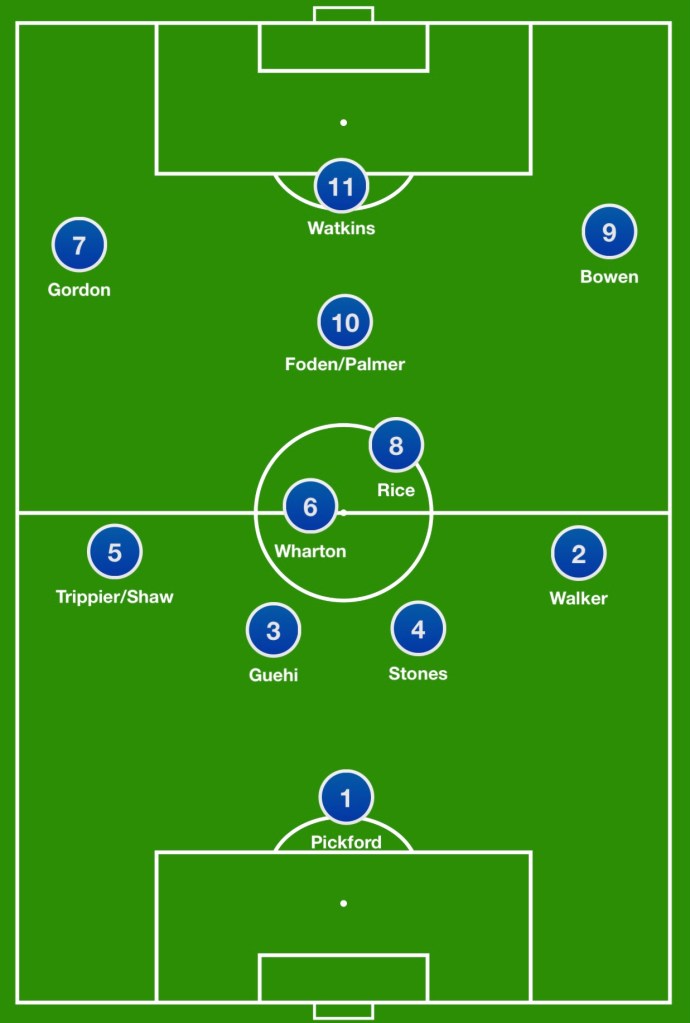
It’s not like the solutions aren’t there; they are. Is Watkins as good as Kane? No. Is Bowen as good as Saka? No (unfortunately). Can Wharton bend in freekicks like Alexander-Arnold? Of course he can’t. But you don’t win football tournaments by having the best players on the pitch – that was the mistake of England in the 2000s – you win by having the best team on the pitch. There is a really good team in this squad. We just have to hope that they get put together.
All football diagrams created with the CoachBoard App.
 Up South
Leave a comment