
The greatest national anthem in the world. That’s how Kelly Cates on BBC Radio 5 Live described “Flower of Scotland” after the last notes of the piper were overtaken by the roar of the Tartan Army on Wednesday. She wasn’t alone. A brief scan of social media will show you kilt-clad beer drinkers singing and dancing in the rain, with the odd bit of helping a woman cross the road or celebrating newlyweds. And amongst the Tartan Army’s theme tune of “We’ll be Coming Down the Road” or the summer hit that is “No Scotland, No Party”, you will hear the national anthem.
And it is good. It is bloody good. Right up there with “La Marseilles”, “Fratelli d’Italia”, and “Hen Wald Fy Nhadau” (although I do have a soft spot for the Azerbaijan national anthem – https://youtu.be/DLaFdEMnyKE?si=zjZctyekgBh2sbOs).
I’ve had the privilege of being in a packed-out Hampden and experiencing the pride that it is sung with. No, not sung – that would imply musical ability and talent. An anthem shouldn’t be sung – it should be belted, it should be yelled, projected at such a volume and with such passion that no one should care whether or not it’s on key. “God Save the King” feels like a droning formality that has to be done to get to the good bit; “Flower of Scotland” feels like a genuine battle cry.
Of course, some of you might be confused. Scotland has an anthem? But it’s part of the UK. And doesn’t the UK have its own anthem? Yes, yes, and also yes. See, the British Union is… how do it put this? A classic example of archaic shenanigans. In 1707, Scotland and England signed the Act of Union to formalise the creation of Great Britain. But there were some caveats, mainly that Scotland would maintain its own judicial system and independent church (or Kirk). But there was always a fear that the more populous, wealthy, and powerful England would swallow up Scotland. Indeed, it was common in the 19th century for foreign observers to describe the whole of the UK as simply England. Some Scots even welcomed this breakdown of identity, referring to themselves as “Northern Britons”, something you absolutely must NOT do under any circumstances today.
There were still nationalists, but the defeat of the Jacobites along with the Highland Clearances, and then the prosperity and representation brought by the Union throughout the Victorian Era silenced them. All that the Unionists would have to do would be to make sure that the money wouldn’t stop going to Scotland, Scottish voices wouldn’t be weakened in comparison to others, and that there would be no other shocks to the Union.
Two global wars, one decolonisation, one Irish War of Independence, partition, and 30-year civil war, 40 years of deindustrialisation, one Brexit almost solely voted for by England, and 25 years of a devolved government clashing with Westminster later… it’s not exactly been smooth sailing.
Flower of Scotland was initially a folk song written in the 1960s, that era of change and a rethinking of the established norms. Sung first at Scottish sports events, it became widespread across the zeitgeist. It recounts the tale of Scotland’s greatest triumph: the victory of Robert the Bruce over Edward II in the First War of Scottish Independence:
Oh, Flower of Scotland, when will we see your like again;
That fought and died for, your wee bit of hill and glen;
That stood against him, proud Edward’s army;
And sent him homeward, to think again;
But there’s a melancholy to it, especially in the later verses. So much has changed in the 700 years between today and Bannockburn. States can’t stay in their own little bubbles – not with intercontinental ballistic missiles, satellites, and the internet.
And Scots of all stripes recognise this. Unionists argue that staying in the Union is the best for a tiny country of 5.5m, and promise a greater level of devolved government and representation at the Westminster level. Meanwhile, Nationalists point to the success of similarly sized countries in the EU and the sheer number who voted to remain. Scotland can’t be exactly as it was, but maybe it can have the same spirit to help it through:
Those days are past now, and in the past they must remain;
But we can still rise now, and be a nation again;
That stood against him, proud Edward’s army;
And sent him homeward, to think again.
It wasn’t mandated as part of the Act of Union, and they were initially much closer to the English than many Scotland fans would be comfortable with, but football has also been a way to preserve a distinct Scottish identity: different fan cultures, tournaments, and associations.
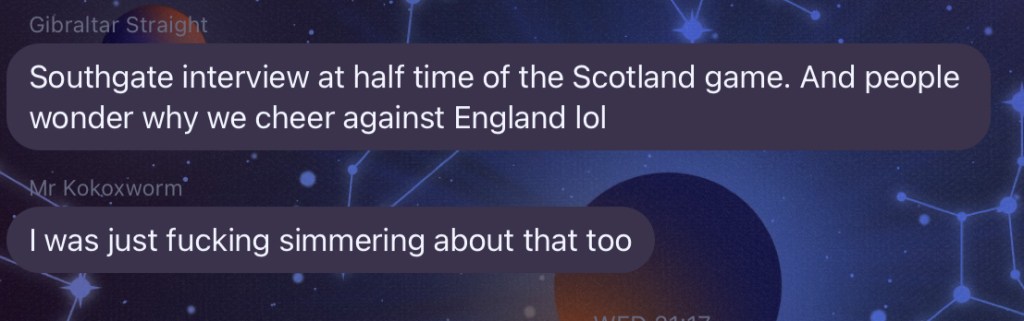
This is not just a proud nation, it’s a proud footballing one. In the past 24 hours, I don’t think anyone has done more for Scottish independence than Gary Lineker and the BBC producers for broadcasting an interview with the ENGLAND manager during halftime of the SCOTLAND game. Yes, they have airtime to fill. Yes, they are both “home nations”. But this really gets Scottish football fans. The footballing discourse, the punditry, the analysis, the time filler. It’s all through an English lens. Does a Scotland fan want to hear whether or not Ollie Watkins is frustrated with not starting instead of analysing how Billy Gilmore suddenly became the greatest midfielder on the planet? No.
Maybe it’s time for those in Southern Britain tae think again – there’s a feeling here it’s been long overdue.
 Up South
Leave a comment